
Looking Beneath the Surface: Inner Experiences in Sufism
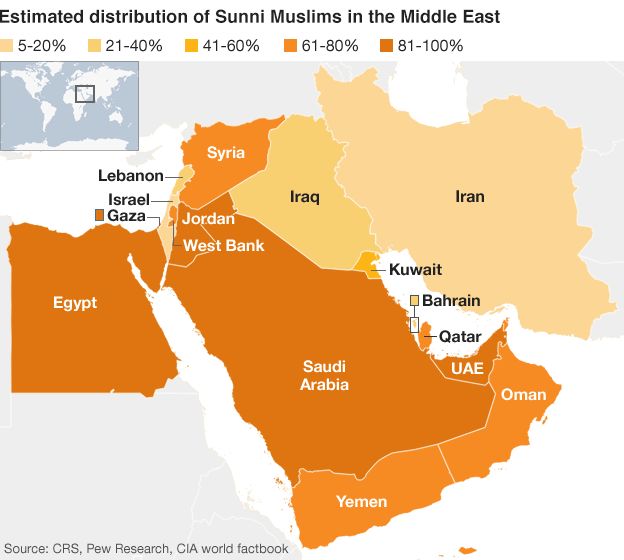
(“Estimated Distribution of Sunni Muslims in the Middle East.” Sunnis and Shia: Islam’s Ancient Schism, BBC News, 4 Jan. 2016.)
Differences between Shia and Sunni Islam in the Middle East have led to conflict and have resulted in violence.
Different religions often tend to clash, unable to coexist in harmony. A prime example are the two major branches of Islam, Shia Islam and Sunni Islam. The Shia-Sunni relation has been one of turmoil for centuries now, often erupting into violence and impacting the Middle East. So when I heard about Sufism during Professor Karimov’s lecture titled “Sufi Poetry” on November 6th, I was intrigued by its detachment from religion as a whole. Sufism is an Islamic doctorate that is based on the importance of personal experiences with God. A key point from Professor Karimov’s lecture was when he mentioned how Sufism cannot be derived to Shia or Sunni Islam, as “Sufism is not about the branch of Islam” (Karimov, “Sufi Poetry” 11/6/18). This caught my attention – I did not expect there to be a way to experience a connection with God without religious affiliation, especially in the Islamic world. And yet Sufism exhibits the quality of universality, since any individual can focus on his/her inner experiences and rely on them to find meaning in life. This led to a question I knew I wanted to explore: what about Sufism allows it to bypass the borders of religion and be universal?
Following Professor Karimov’s lecture, revisiting the poems written by Sufi mystic and poet Rumi led me to my interpretation. For me, the crucial aspect of Sufism is its emphasis on “internal growth”, compared to what I consider “external growth” in other teachings or practices aimed at connecting with God. In Sufism, knowledge, truth, love, and other qualities people strive to achieve by establishing a bond with God come from within you. This idea is expressed in “We Are Three”, in which Rumi writes “Soul receives from soul that knowledge, therefore not by book nor from tongue” (Rumi, ‘We Are Three’, Mathnawi VI, 831-845). According to Sufi practices, all that a “soul receives” comes from the “soul” or the inner person itself. There is no scripture or manuscript (“book”) or religious leader (“tongue”) that outlines how one must experience a personal connection. The relation to scripture reminded me of Dr. Frisina’s October 23rd lecture on St. Paul’s 1st Letter to the Corinthians, in which he explained how scripture served as a go-between capable of linking humankind with God. Scripture allowed a metaphysical God to inform the followers of Christianity, whereas in Sufism, such form of instruction is not present. How a person is affected by Sufism is subjective; therefore, only that person is able to judge the extent of his/her inner connection with God. In a technical sense, others cannot criticize the practices of a Sufi, as they are unable to participate in another’s private experiences. On the other hand, teachings with “external growth”, usually involving religious practices, are a common, shared experience. Although personal experience is present, followers of such teachings are expected to adhere to set principles, whether it be to pray at a specific time or to avoid certain foods. In this way, it is possible to determine outsiders or those who stray from the “ideal” path, which leads to religious boundaries and in some cases, conflict.
I would like to learn more about how Sufism has persisted throughout history. As a discipline rooted in internal introspection, I would think that individuals may become frustrated or lost without a sense of guidance and eventually feel that there is not much to gain on their own. However, I simply may be underestimating the power of personal experience.

(Heredia, Nino Jose. “ Ramadan: A Time for Introspection.” Ramadan: A Time for Introspection, Gulf News, 10 July 2012.)
Inner experiences and introspection are essential to connect with God in Sufism.
Works Cited:
“Estimated Distribution of Sunni Muslims in the Middle East.” Sunnis and Shia: Islam’s Ancient Schism, BBC News, 4 Jan. 2016.
Frisina, Warren. “St. Paul’s 1st Letter to the Corinthians.” Culture & Expression. St. Paul’s 1st Letter to the Corinthians, 23 Oct. 2018.
Heredia, Nino Jose. “ Ramadan: A Time for Introspection.”Ramadan: A Time for Introspection, Gulf News, 10 July 2012.
Karimov, Elyor. “Sufi Poetry.” Culture & Expression. 6 Nov. 2018.
Rumi. We Are Three: New Rumi Poems. Translated by Coleman Barks, Maypop Books, 1987.
 Borderless Butterfly