
Total Equality? Not Yet…
This Thanksgiving Break was full of surprises – some more surprising than others. My sister, a sophomore high school student with newfound curiosity for computer science, recently enrolled in a programming class. She told me about her experience on the first day of class, chronicling, “I walked in and was surprised when I saw that I was the only girl there. It felt weird…” Looking at the bigger picture, however, I realized that my sister’s experience was not unusual. After all, in 2015, women made up 25.5% of those employed in computer and mathematical science occupations (“Women in Science, Technology, Engineering, and Mathematics (STEM).”). And this is not the only area where women are underrepresented…
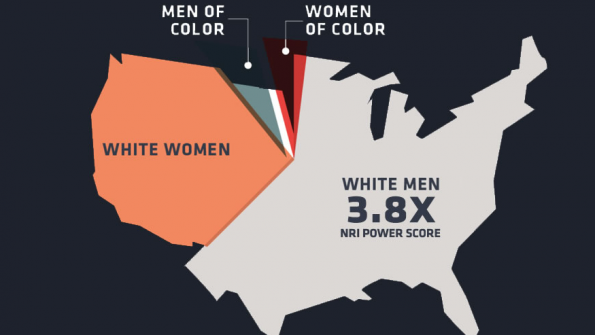
(“Women and Minorites Underrepresented in Government.” Women and Minorites Underrepresented in Government, American City&County, 3 Nov. 2014.)
Even in government, which should ideally represent our nation, women (especially women of color) are far underrepresented.
In her November 20th lecture titled “The Alexiad, Up Close & From a Distance,” Dr. Vimala Pasupathi illustrated the importance of the The Alexiad in a broader context, describing how it is the first major text on the C&E syllabus with a definitive female author. Dr. Pasupathi claimed that this is significant because ultimately, women are far outnumbered by their male counterparts in not only C&E, but in the world of literature. As Dr. Pasupathi puts it, “it has taken far too long for the books that contain women’s work to gain equal status with those that men wrote” leading to a “need to value women’s voices and… to avoid excluding them from our work and our syllabi” (Pasupathi, “The Alexiad, Up Close & From a Distance” 11/20/18). Taken back by Dr. Pasupathi’s words, I wanted to look into why women are not held to the same standards as men in literature.
Dr. Pasupathi pointed to bias and behavior as the reasons for why women are not equally represented, stating “human biases and idiosyncrasies… trend towards keeping female authors off the syllabus” (Pasupathi, “The Alexiad, Up Close & From a Distance” 11/20/18). She explained how works authored by women are intentionally neglected for a variety of reasons. Examples include “she wrote only one work”, “look what she wrote about [implying the author did not write about something compelling]”, and “she had help” (Pasupathi, “The Alexiad, Up Close & From a Distance” 11/20/18). The use of such “excuses” as justification to keep women off the agenda in literature highlights that this is an actively-occurring process; it is not a natural phenomenon. I would like to take this one step further and claim that this is an inherent problem that is present in society. People have become accustomed to excluding women in literature that they are able to use the tiniest reasons to keep women out. I would not be surprised if, at this point, this pattern has become the norm, and people are naturally inclined to favor male authors over female ones. While legitimate reasons could have possibly existed to pick certain male authors instead of female authors in the distant past, those ingrained tendencies cannot continue to affect our decisions today.
This idea of an inherent tendency is present in many aspects of our everyday lives, even with something as simple as watching TV. If television becomes a central part of our early lives and we rely on TV during our development, we will become accustomed to watching TV down the line. While we may learn the negative outcomes of watching TV or become too busy to watch TV, our minds will ignore these thoughts and stick with the norm; often, we will continue to watch TV. We may not even consider it “wrong” or “bad” in any respect, given we grew up with a big emphasis on watching television. This phenomena is observed in many other scenarios in life: eating junk food, playing video games, or taking drugs.

(“Overcoming Unconscious Bias.” Implicit Bias Awareness, Berkeley Lab.)
Overcoming inherent biases and beliefs are key to adequately representing women in literature.
In general, it takes a significant amount of time and effort to break out of an inherent bias. Thus, I would like to ask Dr. Pasupathi how long she believes it would take to reach total equality in literature? In the meantime, it is important we take actions to increase representation of women in not just literature, but in all fields. Based on my sister’s experience, I found this great video on why women are underrepresented in STEM (Science, Technology, Engineering, Math) fields: https://www.youtube.com/watch?v=fQyCBTDproE\
Clearly, the problem is present. It’s time we start to fix it.
Works Cited:
“Women and Minorites Underrepresented in Government.” Women and Minorites Underrepresented in Government, American City&County, 3 Nov. 2014.
Komnene, Anna. The Alexiad. Penguin.
“Overcoming Unconscious Bias.” Implicit Bias Awareness, Berkeley Lab.
Pasupathi, Vimala. “The Alexiad, Up Close & From a Distance.” Culture & Expression. 20 Nov. 2018.
“Women in Science, Technology, Engineering, and Mathematics (STEM).” Catalyst, 22 Aug. 2018, http://www.catalyst.org/knowledge/women-science-technology-engineering-and-mathematics-stem.
Ziadie, Chelsea. “The Underrepresentation of Women in STEM.” 13 May 2015.
 Borderless Butterfly